
How to check a BIS hallmark on gold jewellery

The short answer: look for three marks on the piece: the BIS logo, the purity, and a six-character code called the HUID. Then type that code into the free BIS Care app, under “Verify HUID”. If the jeweller cannot show you all three marks through a magnifying glass, do not pay yet.
“BIS hallmark check” is searched on Google in India about 4,400 times a month. Everything below comes from the Bureau of Indian Standards’ own pages, which we read on 4 October 2026.

What a hallmark is
Hallmarking is an official test of how much precious metal an item really contains. In India the Bureau of Indian Standards, known as BIS, runs the scheme, and it covers gold and silver.
A jeweller does not stamp the hallmark. The piece goes to a separate assaying and hallmarking centre recognised by BIS, which tests it and marks it. BIS calls this a third-party assurance: someone other than the seller has confirmed the purity.
The three marks to look for
Since 1 July 2021 a hallmark on gold has three parts:
- The BIS logo.
- The purity, shown as carats and as fineness, for example 22K916.
- The HUID, a six-character code of letters and numbers. It is different on every item.
The marks are tiny. The largest size allowed on gold is 1.5 mm high, and the smallest is 0.5 mm. That is why a registered jeweller must keep a magnifying glass of at least 10x to show them to you. Ask for it.
How to check the code
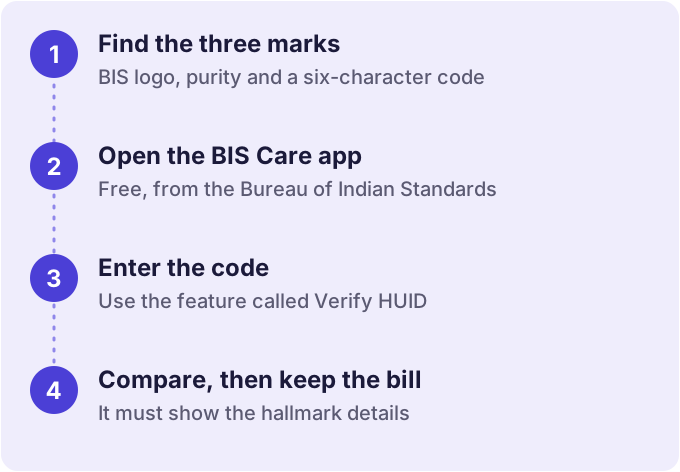
- Find the three marks on the piece and read the six-character HUID.
- Install BIS Care. It is the official BIS app, free on Android and iOS, in 12 languages. You register with your mobile number. The download links are on the BIS Care page.
- Open “Verify HUID” and enter the code.
- Compare what the app shows with the piece in your hand and with what the jeweller told you.
Do this before you pay, not after. BIS itself says the feature can be used to verify purity before purchase.
What the purity numbers mean
Fineness is parts of gold in every 1,000. The Indian standard allows six grades for hallmarked gold. If a piece is sold as 22 carat, the mark should read 916.
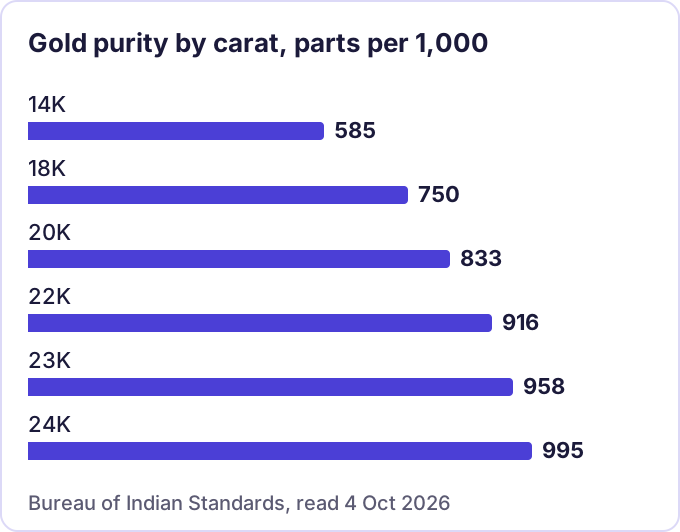
See the numbers as a table
| Carat | Fineness (parts of gold per 1,000) |
|---|---|
| 14K | 585 |
| 18K | 750 |
| 20K | 833 |
| 22K | 916 |
| 23K | 958 |
| 24K | 995 |
What to look for in the shop
BIS lists four things a registered jeweller must have. They take a minute to check:
- The BIS logo outside, with the words “Hallmarked jewellery available for sale”.
- The certificate of registration from BIS, on display.
- A magnifying glass of at least 10x.
- A chart showing how carats relate to fineness.
Two more points catch people out. In a pair, such as earrings, each piece should have its own hallmark with a different HUID, and so should any part that can be detached. And the hallmarking charge is small and fixed: 45 rupees per gold article, whatever it weighs. It does not include making or wastage charges.
Always take a proper bill
BIS says a bill is necessary, and that it must carry the details of the hallmarked article. Without it you have little to stand on in a dispute. Check that the bill shows the purity and the HUID before you leave.
If you doubt the purity later
Anyone can have jewellery tested at a BIS recognised assaying and hallmarking centre. The charge is 200 rupees for a fire assay test.
If hallmarked jewellery is found to be less pure than its mark, BIS’s consumer protection page says the buyer is entitled to compensation: two times the difference in value for the shortage, plus the testing charges. You can also report misuse of the mark through “Complaints” in the BIS Care app.
The full list of official answers is in the BIS hallmarking questions.
Where EveryNearby fits
We list jewellery shops across India, and each listing says whether, and when, it was last checked. That check is about the shop’s own website. It is not a check of its gold. How we check sets out exactly what we look at.
Use the listing to find a shop and see how fresh its details are. Use the three marks and the app to check the gold.
Questions people ask
What is HUID on gold jewellery?
HUID stands for Hallmark Unique Identification. The Bureau of Indian Standards describes it as a six-digit alphanumeric number that is unique to each hallmarked item and traceable. It is one of the three marks in a hallmark.
How can I check a hallmark online for free?
Use the BIS Care app from the Bureau of Indian Standards. It is free on Android and iOS. Open the Verify HUID feature and enter the six characters stamped on the piece.
What does 916 mean on gold?
916 is the fineness for 22 carat gold: 916 parts of gold in every 1,000. The standard allows six grades for hallmarked gold, from 14 carat (585) to 24 carat (995).
Do both earrings in a pair need a hallmark?
Yes. The Bureau of Indian Standards says each article in a pair, and every detachable part, should carry a hallmark with a different HUID.
What can I do if hallmarked gold turns out to be less pure?
You can have it tested at a BIS recognised assaying and hallmarking centre. If the purity is lower than marked, the buyer is entitled to compensation of two times the difference in value for the shortage, plus the testing charges.
Does EveryNearby check whether a jeweller sells hallmarked gold?
No. A Checked date on EveryNearby means the shop's own website was live and showed its name or phone number on that date. It says nothing about hallmarks, so check the piece itself.